Vermont’s Political Landscape: What Newcomers Should Know Before Moving
- Michael Carrel
- May 9
- 10 min read

Vermont has a political reputation.
To many people outside the state, Vermont is known as progressive, environmentally minded, independent, community-focused, and politically blue.
And that reputation is partly true.
Vermont has sent Bernie Sanders to Washington for decades. It often votes Democratic in presidential elections. It has a strong environmental identity. It has a visible progressive political culture, especially in places like Burlington, Brattleboro, Montpelier, and many college-town or arts-oriented communities.
But if you are thinking about moving to Vermont, here is the important thing to understand:
Vermont politics are more complicated than the national stereotype.
Yes, Vermont is generally left-leaning at the federal level.
But Vermont also repeatedly elects Republican Governor Phil Scott, a moderate Republican who has remained popular in a state that otherwise votes heavily Democratic in national elections.
That is the Vermont political landscape in one sentence:
Progressive values, local independence, deep concern about affordability, and a strong streak of moderation when voters think things are getting too expensive.
In other words, Vermont politics are not as simple as “blue state equals one kind of voter.”
Grab a coffee.
Maybe a town meeting warning.
Let’s talk about it.
Vermont is politically blue — but not one-dimensional
At the national level, Vermont is one of the most reliably Democratic-leaning states in the country.
Democratic presidential candidates usually win Vermont comfortably. Bernie Sanders, an independent democratic socialist who caucuses with Democrats, has represented Vermont in Washington for decades. The state is often associated with progressive views on healthcare, climate change, education, labor rights, and economic inequality.
So yes, Vermont is politically progressive compared with much of the country.
But that does not mean every town feels the same politically.
Burlington is not the same as rural Franklin County. Brattleboro is not the same as parts of the Northeast Kingdom. A college town is not the same as a working-class town. A ski town is not the same as a farming community.
Vermont has:
Progressives
Democrats
Moderates
Independents
Libertarian-leaning rural voters
Old-school Republicans
Environmental activists
Fiscal conservatives
Town-meeting traditionalists
People who vote differently depending on the office
People whose politics are basically, “Please stop raising my taxes”
This is one of the things newcomers need to understand.
Vermont is small, but politically, it has layers.
Like an onion.
A very cold onion with property taxes.
Phil Scott explains a lot about Vermont politics
One of the most interesting things about Vermont is that it can vote heavily Democratic for president while also electing a Republican governor by a large margin.
Governor Phil Scott is central to understanding that.
Scott is not a national-style culture-war Republican. He is widely viewed as a moderate. He has often clashed with the Democratic-controlled Legislature over taxes, fees, affordability, climate mandates, and spending.
That matters because it shows something important:
Vermont voters may support progressive goals, but many also worry about the cost of those goals.
A voter may like environmental protection, strong schools, public services, and social programs — and still be deeply concerned about property taxes, housing costs, electric bills, heating costs, and whether ordinary people can afford to stay.
That tension shapes a lot of Vermont politics.
The big political issue: affordability
If you want to understand Vermont politics right now, start with affordability.
Housing is expensive. Property taxes are a major concern. Heating costs matter. Childcare can be hard to find and expensive. Healthcare access varies by location. Education funding is under pressure. Flood recovery and climate adaptation cost money.
A lot of Vermont political debate comes back to one question:
How do we protect what people love about Vermont without making Vermont unaffordable for the people who live here?
That question shows up in debates over:
Housing
Education funding
Property taxes
Climate policy
Renewable energy mandates
Act 250 and land-use rules
Short-term rentals
Childcare
Healthcare
Municipal budgets
Road and flood repairs
For newcomers, this is important.
You may move to Vermont because you love the scenery, the slower pace, the small towns, and the values.
But the people already here are also asking:
Can we afford to keep living here?
That concern is not theoretical. It shapes elections, town meetings, local budgets, and state policy debates.
Housing politics are everywhere
Housing may be the most practical political issue in Vermont.
Vermont needs more housing, but building housing is complicated.
Why?
Because Vermont also values:
Small-town character
Environmental protection
Farmland preservation
Forest conservation
Local control
Historic village patterns
Careful development
Clean water
Scenic landscapes
Those values are real. They are part of what makes Vermont Vermont.
But they also create tension.
People want housing to be more affordable, but they may oppose large developments near them. Towns want young families, workers, teachers, nurses, tradespeople, and service workers — but may not have enough homes for them to live in.
This creates the classic Vermont political contradiction:
We need more housing. But please do not ruin the town.
Both sides have a point.
Newcomers should understand that housing debates can get emotional because they touch almost everything: taxes, schools, workforce, environment, class, tourism, retirement, second homes, and local identity.
If you move here, you are not just buying or renting in a housing market.
You are entering a political conversation about who Vermont is for.
Education and property taxes are deeply connected
Education is another major political fault line.
Vermont has many small schools, and many towns are deeply attached to them. In some communities, the local school is not just a school. It is part of the town’s identity.
But small schools can be expensive to operate, especially with declining enrollment. At the same time, education property taxes can put pressure on homeowners.
For newcomers, the practical takeaway is this:
Before buying a home, research the school district and the tax picture.
Do not just ask:
“Are the schools good?”
Ask:
What are the school budget trends?
Are property taxes rising?
Is the local school facing consolidation pressure?
Are there school board debates?
How long is the bus ride?
Are there programs your child needs?
Is the town trying to keep a small school open?
Is the district financially stressed?
In Vermont, school politics are local, emotional, and financially important.
Also, if you attend a school budget meeting, bring patience.
And maybe snacks.
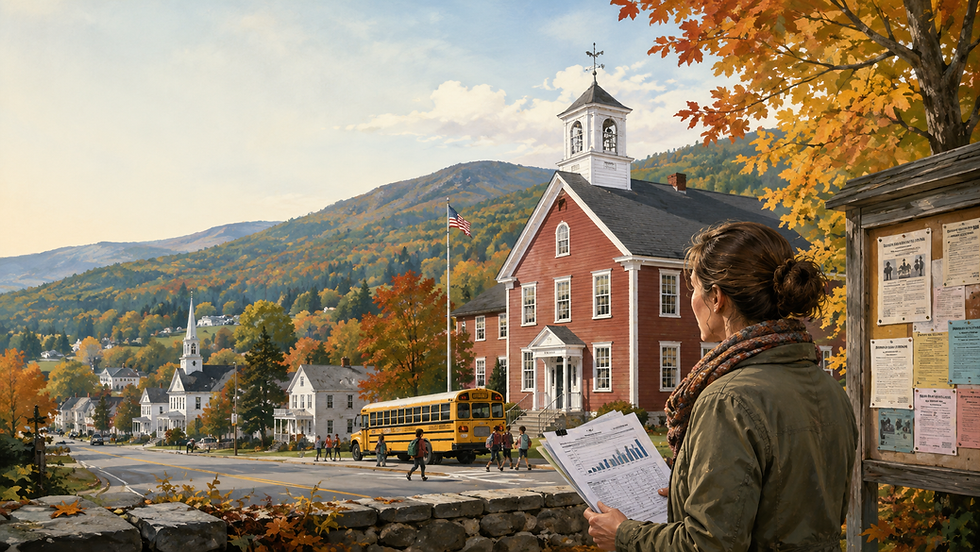
Vermont politics are very local
One of the biggest adjustments for newcomers is how local Vermont politics can be.
Town government matters here.
Town meeting matters. Selectboards matter. School boards matter. Planning commissions matter. Zoning boards matter. Town clerks matter. Road crews matter. Library trustees may matter more than you think.
In a larger state or metro area, local government can feel distant. In Vermont, local government may directly affect your daily life.
Your town may vote on:
School budgets
Road budgets
Fire and rescue funding
Zoning changes
Short-term rental rules
Local development
Transfer station policies
Town building repairs
Land conservation
Local tax rates
You may hear people debating issues at the general store, library, town meeting, Facebook group, or while standing in line behind someone buying one coffee and somehow discussing culvert replacement.
This is Vermont.
Politics is not only national. It is local, practical, and sometimes extremely specific.
If you move here, learn your town.
Who is on the selectboard? When is town meeting? Where are agendas posted? What issues are people arguing about? Is the school budget controversial? Are there zoning changes coming?
Local politics can affect your taxes, roads, services, schools, and quality of life.
Climate and environmental politics are major forces
Vermont has a strong environmental identity.
People care about land, water, forests, farms, mountains, trails, wildlife, and climate change. That environmental ethic is one of Vermont’s defining features.
But environmental policy also creates political tension because climate goals often come with costs, regulations, or lifestyle changes.
Recent debates have included renewable energy requirements, climate accountability, flood resilience, transportation emissions, home heating, development rules, and electric utility costs.
That is the pattern:
Many Vermonters support climate action.
Many Vermonters also worry about whether climate policy will raise costs for people who are already struggling.
Again, Vermont politics often comes back to affordability.
Rural Vermont and urban Vermont can feel politically different
Vermont’s political map is not as simple as “cities blue, rural areas red,” but there are real differences between regions.
More progressive politics are often associated with places like Burlington, Brattleboro, Montpelier, college-town areas, and some artsy or resort communities.
More conservative or moderate voting patterns can be found in many rural, working-class, agricultural, northern, and eastern areas.
But even that is too simple.
A rural voter may support environmental conservation but oppose new taxes.
A progressive voter may want housing but oppose development that feels too large.
A Republican voter may strongly support local schools.
An independent voter may vote for Bernie Sanders and Phil Scott on the same ballot.
Vermont voters can be hard to categorize if you only use national political boxes.
That is part of the state’s political personality.
Local control is a Vermont value
One of the strongest political values in Vermont is local control.
People may disagree on policy, but many Vermonters care deeply about local decision-making.
This shows up in debates about:
Schools
Zoning
Housing
Energy projects
Town budgets
Road policies
Development
Conservation
Short-term rentals
Newcomers should be sensitive to this.
If you move into a small town and immediately start saying, “Here’s how we did it where I came from,” you may not win hearts.
Even if your idea is good.
Especially if you say it during your first town meeting.
A better approach is:
Listen first
Learn the town history
Understand local concerns
Ask questions
Support local institutions
Build trust before proposing big changes
Vermont towns are not blank slates.
They are living communities with memory.
The Progressive Party matters too
Vermont is unusual because the Vermont Progressive Party has had more influence than most third parties in American politics.
Progressives have been especially important in Burlington and in some state legislative races. They often work in alliance with Democrats, but they are not simply the same thing.
This gives Vermont politics a different flavor.
On many issues, the debate is not only Republican vs. Democrat. Sometimes it is:
Progressive vs. moderate Democrat
Legislature vs. governor
Local control vs. state-level reform
Environmental goals vs. affordability
Housing need vs. town character
Tax relief vs. public services
That makes Vermont politics interesting.
Also exhausting, depending on how many meetings you attend.
What newcomers should know socially
Politics can matter socially in Vermont, but how it shows up depends on the town.
In some communities, politics may be very visible. Yard signs, local activism, school debates, town meeting arguments, and social causes may be part of community life.
In other places, people may be more private or practical. They may care less about national labels and more about roads, taxes, schools, plowing, and whether the town can keep the fire department staffed.
A good newcomer rule:
Do not assume everyone in Vermont thinks the same way.
Even in a progressive state, there are plenty of moderates, conservatives, independents, and people who are simply tired of everything costing more.
Also, small towns remember how you treat people.
Being respectful matters more than being politically clever.
If you are politically conservative
If you are politically conservative and thinking about Vermont, you should know that the state as a whole leans left, especially on national politics and many social issues.
But you will not be the only conservative in Vermont.
There are Republican and conservative voters throughout the state, especially in more rural areas. Governor Scott’s continued popularity shows that moderate Republican politics can still be very successful in Vermont.
That said, if you are looking for a strongly conservative political environment, Vermont may not feel like the best cultural fit, especially in more progressive towns.
Choose your town carefully.
If you are politically progressive
If you are politically progressive, Vermont may feel appealing.
But you should also know that Vermont progressivism is not unlimited enthusiasm for every new program, tax, or regulation.
Many Vermonters support progressive values but are increasingly concerned about affordability.
If you move here expecting everyone to support every progressive policy automatically, you may be surprised.
The politics here are often more practical than ideological.
People may ask:
How much will it cost?
Who pays?
Will this raise property taxes?
Will this help working Vermonters?
Will this hurt small towns?
Will this make it harder to build housing?
Will this preserve what we love about Vermont?
Those questions matter here.
If you are politically moderate or independent
If you are moderate or independent, Vermont may make more sense than the national stereotypes suggest.
Many Vermonters split tickets, think locally, and evaluate candidates based on personality, competence, and practical concerns.
The same state can vote strongly Democratic for president and overwhelmingly reelect a Republican governor.
That is not confusion.
That is Vermont.
What to research before choosing a town
If politics and community culture matter to you, research the town before moving.
Look at:
Recent election results
School budget votes
Town meeting minutes
Selectboard agendas
Local newspaper coverage
Zoning debates
Housing discussions
School consolidation issues
Short-term rental debates
Local Facebook or Front Porch Forum tone
Community events
Church, civic, and volunteer life
Also visit.
A town’s politics are not just its election results. They are how people talk, what they prioritize, what they argue about, and how they treat each other afterward.
That last part matters.
Questions to ask before moving
Before choosing a Vermont town, ask:
Is this town more progressive, moderate, conservative, or mixed?
Are local taxes a major concern?
Are school budgets controversial?
Is there debate over housing development?
Is the town growing, shrinking, or aging?
Are newcomers welcomed or viewed cautiously?
Is there tension around second homes or short-term rentals?
Are local services financially stable?
What issues dominate town meetings?
Do I feel comfortable participating respectfully here?
You do not need a town that agrees with you on everything.
You need a town where you can live, listen, contribute, and understand the tradeoffs.
Final thoughts: Vermont politics are local, practical, and complicated
Vermont is a progressive state in many ways.
But it is also independent, local, skeptical, and deeply concerned about affordability.
Its voters can elect Bernie Sanders and Phil Scott. They can support climate action and worry about electric bills. They can value small schools and worry about property taxes. They can want more housing and fear losing town character.
That is Vermont politics.
Not simple.
Not one-size-fits-all.
And not always what newcomers expect.
If you are moving here, do not just ask whether Vermont is “blue” or “red.”
Ask better questions:
What does this town value? What does it cost to live here? How do people solve problems? How do locals treat newcomers? What issues are shaping the community? And can I participate with humility, patience, and respect?
Because in Vermont, politics is not just something that happens on television.
It happens at town meeting.
It happens in school budget votes.
It happens in zoning discussions.
It happens when your neighbor has a strong opinion about road salt.
And if you move here, sooner or later, it will become part of your daily life too.
Want the honest version of Vermont life before you move? Purchase The Honest Guide to Moving to Vermont. It covers town choice, small-town culture, housing, winter, costs, and the questions newcomers should ask first.


Comments